Where the Tide Turns: An Afternoon at Mekari, the Strait's Narrowest Squeeze
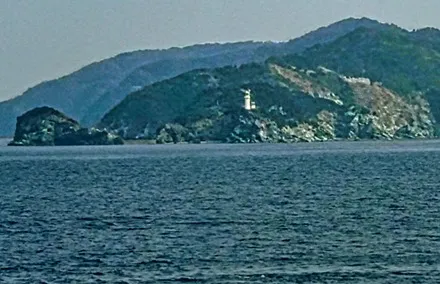
Photo: Mekari lighthouse Kanmon Strait white lighthouse ships narrow strait Japan, via baderjournal.com
There's a moment at Mekari Park that catches most first-timers off guard. You've huffed up a short but honest hill from the bus stop, you're expecting a nice view of the water, and then you round the corner and the Kanmon Strait is just there — a churning, glittering funnel of water barely 600 meters across, with container ships, fishing boats, and the occasional tanker threading through like it's a two-lane highway. Which, in a very real sense, it is.
This is the narrowest point of the strait, the spot where the Seto Inland Sea and the Sea of Japan trade water twice a day, and where the currents can hit a muscle-tightening 10 knots. Stand at the railing long enough and you can actually watch the water change texture — rippling, swirling, sometimes forming standing waves that look like a river running sideways through the sea.
A Lighthouse With a Résumé
The white tower at the park's edge is the Mekari Lighthouse, first lit in 1872 and widely considered the oldest western-style lighthouse in Japan. It's had a few rebuilds — the current concrete version dates to the 1960s — but the job description hasn't changed: guide ships safely through one of the trickiest passages in the country.
On clear days the tower is open to the public, and for a couple of hundred yen you can climb the spiral staircase to the gallery. It's a short climb by lighthouse standards — nothing like the lighthouses back home on the Maine coast — but the payoff is a full 360-degree panorama: Shimonoseki and Honshu on one side, Moji and Kyushu on the other, and the strait itself doing its slow, powerful churn directly below.
Check locally whether the tower is open on your date; access hours vary by season and weather, and it's occasionally closed on weekdays outside peak periods.
The Current Is the Show
Here's the thing most guidebooks miss: the lighthouse is great, but the water is the main event. Mekari sits right where the tidal flows from two different seas collide, and the timing of the tide completely changes what you'll see.
- Slack tide: The strait calms down, ships bunch up, and the water turns glassy. Nice for reflections, less dramatic.
- Peak current: Whirlpools, tide rips, and whitecaps in the middle of a strait. This is when photographers should be there.
You can find tide tables for the Kanmon Strait online (search for "Kanmon Strait tide chart" or 関門海峡 潮見表), and it's worth the five minutes of homework. Plan to arrive about an hour before peak flow and you'll get the full show.
Getting There Without a Car
Mekari Park is one of the few major strait viewpoints you can reach on public transit, though it takes a little patience. From Shimonoseki Station, catch a Sanyo bus toward Mekari and ride it to the Mekari Park stop — roughly 30 minutes, give or take. Buses run hourly-ish, so check the timetable at the tourist office or snap a photo of the posted schedule before you head out.
Wear real walking shoes. The path from the bus stop to the lighthouse climbs steadily through a wooded hillside, and while it's only about 15 minutes, the grade will remind you it exists. There are restrooms and a small visitor facility near the tower, and picnic tables scattered around the lawns.
Why Photographers Keep Coming Back
Mekari does something few viewpoints in Japan manage: it gives you ships, water, and two city skylines in a single frame, at a scale that feels almost miniature. Long-lens shooters can compress the strait until a car carrier looks like it's sailing through downtown Shimonoseki. Sunset turns the water copper, and after dark, the Kanmonkyo Bridge lights up on the eastern horizon.
A few practical notes for the camera crowd:
- The best ship traffic tends to cluster around tidal changes, same as the currents.
- Bring a polarizer — glare off the strait is real, especially midday.
- Morning light favors the Kyushu side; late afternoon flatters Shimonoseki.
- It gets windy at the rail. Like, hat-eating windy.
Pair It With the Rest of the Strait
Mekari combines naturally with a visit to the Kanmon Strait area's other highlights. Many travelers ride the bus back toward town and hop off at Danjo Garan or continue to Karato Market for a late seafood lunch. If you're driving, the park has free parking and makes an easy first or last stop on a loop around both sides of the strait.
But honestly? It's worth the trip on its own. There's something about standing at the thinnest point between two islands, watching Japan's maritime traffic squeeze past a 150-year-old lighthouse, that makes the whole Kanmon region click. This isn't a place you stumble into — it's a place you plan for. Plan for it.