The Child Emperor and the Vermilion Gate: A First-Timer's Guide to Akama Shrine
Photo: 설총, CC BY-SA 3.0, via Wikimedia Commons
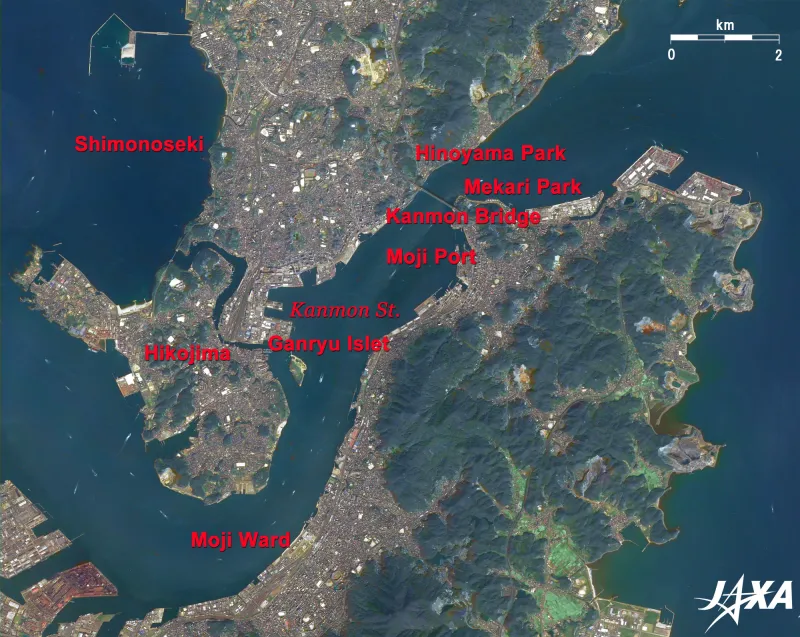
Walk down toward the water in Shimonoseki's Tamonomae neighborhood and you'll spot it before you understand it: a wall of vermilion red, all curved roofs and lacquered beams, sitting practically on top of the Kanmon Strait. This is Akama Shrine, and unlike most Japanese shrines, it wasn't placed here for scenery. It was placed here for a grave.
If your Shimonoseki itinerary is built around Karato Market and the fugu counters — no judgment, both are excellent — consider this your nudge to add ninety minutes for something quieter. Because Akama Shrine is where the Kanmon Strait stops being a pretty backdrop and starts being a story.
The Boy Who Wouldn't Retreat
Quick history, minus the textbook voice. In 1185, the rival Genji and Heike clans fought their final battle at Dannoura, right here in the strait. The Heike were losing badly. Rather than let eight-year-old Emperor Antoku — a child, the puppet emperor of the doomed clan — be captured, his grandmother Taira no Tokiko took him in her arms and stepped into the sea. Much of the Heike court followed.
It's one of the most famous moments in Japanese history, the kind of story every schoolkid here knows the way American kids know the Alamo. Antoku's body was recovered near Shimonoseki, and Akama Shrine was eventually built on the spot to honor his spirit — and the spirits of the Heike warriors who died with him.
Here's the detail that gets everyone: the shrine's main hall, the Hoheiden, is built to face the strait directly. Not the mountains, not the road — the water. The Heike court lost the capital, lost the war, and lost the emperor, so the shrine gives them a palace facing the sea forever, gazing out at Dannoura. The interior is modeled on Kyoto's imperial palace, a miniature version of what the child never got to grow up ruling.
The whole thing is painted that vivid red-orange vermilion, and on a clear morning with the strait glittering behind it, it's genuinely one of the most striking sights in western Japan. Bring a camera, obviously. But also bring a few minutes of stillness.
Shrine Etiquette, the Low-Stress Version
If shrines make you nervous because you're afraid of doing something wrong — relax. Nobody expects a visitor from Ohio to know Heian-period ritual, and the basics take thirty seconds to learn:
- At the torii gate: Give a slight bow as you pass through. Walk to the side of the path rather than dead center — the center is considered the deity's route.
- At the purification fountain (temizuya): If it's in use, scoop water with the ladle, rinse your left hand, then your right, then (optional) a little in your palm for your mouth. Don't drink directly from the ladle. Don't stress about perfection.
- At the main hall: Toss a coin in the offering box (five yen is the lucky amount — go-en sounds like the word for "good fortune/connection"), bow twice, clap twice, pray silently, then bow once more.
- Photos: Fine outdoors in general. Look for signage before photographing inside the halls, where the imperial-style interior is the star.
That's it. That's the whole exam. Locals will tell you the most respectful thing you can do is simply be present — this is an active memorial site, not just a photo op.
The Eerie, Beautiful Part: 800 Years of Memorials
Here's what turns a nice shrine visit into the thing you'll remember from your whole trip. Every year, Akama Shrine holds memorial services for Antoku and the Heike dead — services that have been performed, in one form or another, for centuries. The most famous is the Sento-sai in early August, where hundreds of lanterns are floated onto the strait to guide the spirits of the drowned.
Imagine that for a second: an annual act of remembrance for a child who died in 1185, still happening on the same stretch of water. There are very few places in the United States where you can stand in a tradition that old — it predates the printing press, the Renaissance, basically everything we treat as "old" back home.
If your visit lines up with the festival, rearrange your plans. If it doesn't, the shrine's museum displays Heike-related treasures, including armor and artifacts connected to the clan, and the grounds themselves reward a slow loop. There's also a statue of the dancing girl Shizuka Gozen on the grounds — ask a docent or read the placards; the Heike lore runs deep here.
Making the Visit Work
Akama Shrine is an easy add-on to any Shimonoseki day. It's about a 15-minute walk from Shimonoseki Station, and it pairs naturally with Karato Market (go in the morning, eat your weight in seafood, then walk it off here). The strait-side setting means you can continue on to the waterfront promenade or the Kanmonkyo Bridge viewpoints afterward.
Timing tip: go early or late in the day. Midday cruise crowds exist, and the shrine's whole mood is contemplative. At 7 a.m., with gulls overhead and freighters sliding past a vermilion wall, you'll understand why this spot was chosen.
Shimonoseki will happily fill your stomach. Akama Shrine is the place that fills in the rest — the reason the strait feels heavier, older, and more alive than any postcard suggested. Eight hundred years later, the boy emperor is still watching the water. You should too.