Six Span Stories: What Driving the Kanmonkyo Bridge Actually Feels Like
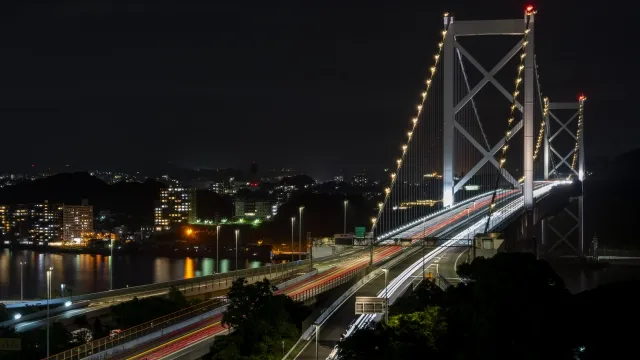
Photo: Kanmonkyo Bridge Kanmon Strait suspension bridge Japan night illumination, via trip.kabudata-dll.com
If you've ever driven the Golden Gate at rush hour, you know that famous bridges have a way of turning into traffic statistics. The Kanmonkyo Bridge — the 1,068-meter suspension span that's carried cars between Honshu and Kyushu since 1973 — has the opposite problem. Most travelers blast across it without ever pulling over, which is exactly why you should slow down.
The Longest Suspension Span in Japan (Yes, Really)
Here's a fact that surprises most American visitors: the Kanmonkyo was Japan's longest suspension bridge when it opened and remains the country's longest today at 1,068 meters of main span. Not Akashi Kaikyo, not anything in Tokyo — those beat it in total length, but the main suspended span between towers belongs to this modest strait crossing.
Think of it this way: the Golden Gate's main span is 1,280 meters. The Kanmonkyo isn't far behind, and it's doing the same job — connecting two landmasses over a busy shipping channel — just with far less fanfare. The strait below is one of the busiest waterways in Japan, with hundreds of vessels passing daily between the Sea of Japan and the Pacific.
Driving It: What to Expect
The crossing takes about two minutes by car, and the toll is a few hundred yen — pocket change by US bridge standards. You'll approach from the Shimonoseki side (Honshu) or the Moji side (Kyushu), and honestly, the view is good in both directions.
A few practical notes for American drivers:
- No pedestrian or bicycle access. Unlike the Golden Gate, you can't walk the Kanmonkyo. You're in a car, a bus, or you're not crossing it.
- Tolls are cash or card at the booth — have your IC card (Suica, ICOCA) ready for a smoother run.
- The wind is real. The strait funnels weather, and on gusty days you'll feel it in the steering wheel. It's normal, but first-timers notice.
- Speed cameras exist. The speed limit drops on the bridge. Don't learn this the expensive way.
Where to Actually See the Bridge
Since you can't walk it, the viewpoints matter — and the region delivers.
The Observation Decks
Both sides of the strait have pedestrian-friendly observation facilities built into the bridge approach. The Kanmonkyo Observatory on the Moji side sits high on the hillside in Mekari Park and gives you the classic postcard angle: the full span with the strait's shipping traffic threading beneath it. The Shimonoseki side deck puts you closer to the water and closer to the bridge's steel bones.
Both are free or nearly free, both have parking, and both beat anything you'll see through a windshield.
Mekari Park
On the Kyushu side, Mekari Park combines the observatory with walking trails and a small maritime history exhibit. Time your visit for late afternoon and you can watch the strait shift from working waterway to silhouette.
From the Water
The Kanmon ferries and sightseeing cruises run beneath the bridge constantly. Seeing 100-plus meters of steel tower pass directly overhead from a boat deck is the perspective most visitors skip — and the one photographers should chase.
The Night Show
The Kanmonkyo is illuminated nightly, and the color often changes with seasons and events. The best move for US travelers used to driving everywhere: park on the Moji side, stroll the Mojiko Retro waterfront (brick warehouses, restaurants, a general old-port charm that reads like a small-town main street), and watch the bridge light up across the water with Shimonoseki glittering behind it.
Bring a light jacket. The strait breeze after dark is no joke, even in summer.
Making a Day of It
The bridge pairs naturally with the rest of the region. Cross in the morning, hit Karato Market in Shimonoseki for a sushi breakfast, wander the Mojiko waterfront in the afternoon, and finish with the illumination at night. One rental car, one bridge, two islands, zero regrets.
If your US travel style involves planning trips around iconic drives — the Pacific Coast Highway, the Blue Ridge Parkway — add this to the list. It's shorter, stranger, and you'll have it mostly to yourself.